How to tell your therapist you've been tracking your mood
You've been checking in with yourself for a couple of weeks and you think it's useful. Now you have to say so out loud. It can feel oddly awkward, like handing in an assignment nobody asked for. It doesn't have to be. A sentence or two is enough.
You don't need a big announcement
Most therapists are glad to hear that a client is paying attention to their own days. You don't have to explain an app or present a pile of data. Say what you did and why, and let your therapist decide how useful it is.
- "I've been writing down how I feel each day, and I noticed something I'd like to talk about."
- "I've started a quick daily check-in. Would it help if I showed you what it looks like?"
- "I keep forgetting things between sessions, so I've started keeping notes."
Start with one thing you noticed
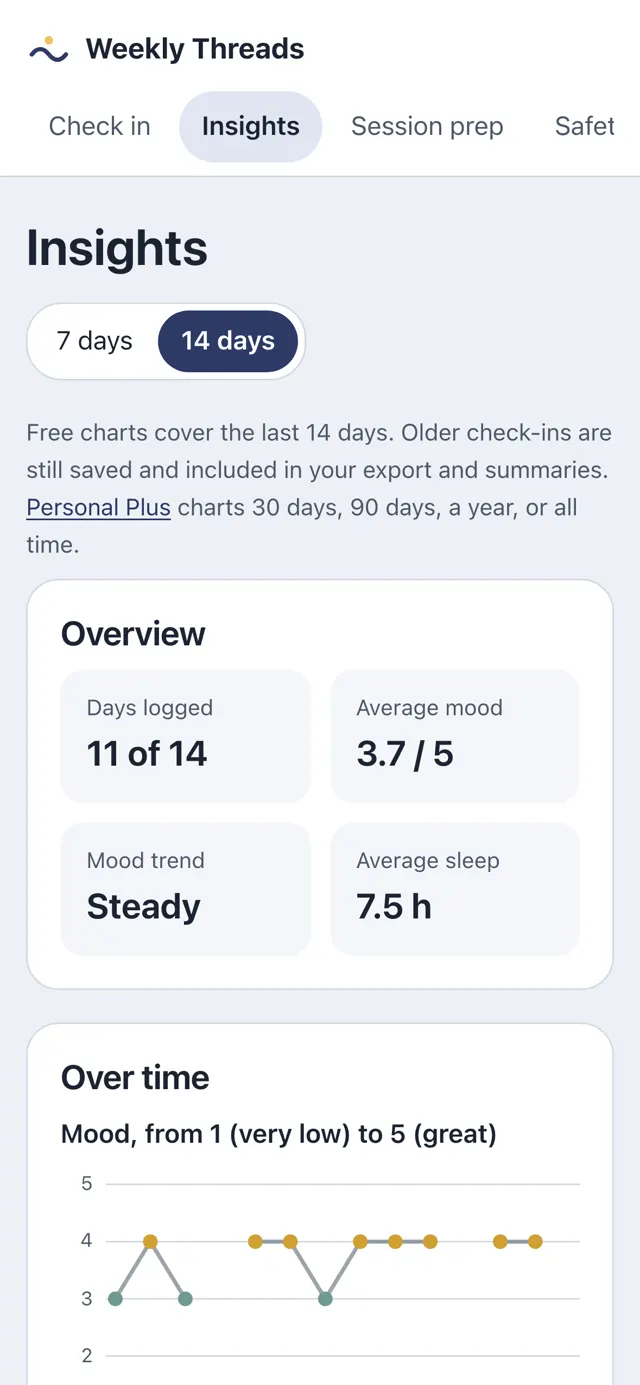
The easiest opening isn't the tracking itself, it's what it showed you. Maybe your mood dipped on the same two days each week, or the nights you slept badly were followed by your hardest afternoons.
One concrete observation gives the conversation somewhere to go. You can offer the rest later if your therapist asks for it.
Offer a summary instead of your phone
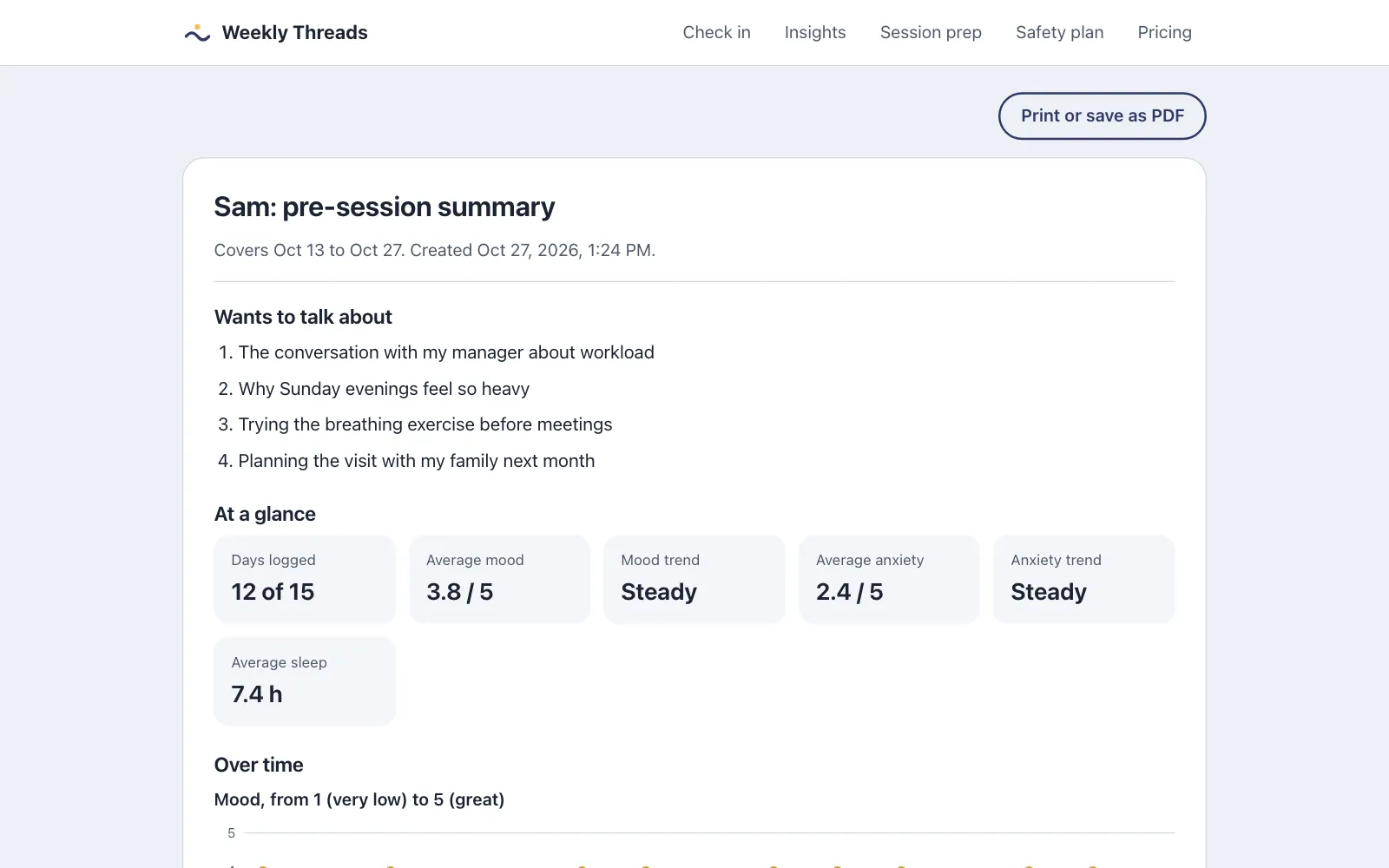
Scrolling through an app in the room can eat the hour. A one-page summary is easier on both of you: your therapist can read it before the session, or look at it for a minute at the start.
In Weekly Threads, you create a summary link from the Session prep page. Your therapist opens it in any browser, with no account and nothing to install, and can print it or save it as a PDF.
If it feels awkward
A few things people worry about, and what may help:
- "It feels like homework." You can say so. "I'm trying this, but I don't want it to become one more thing to do right." That's useful for your therapist to know.
- "I'm afraid they'll judge the numbers." A number is a snapshot of one day, not a score on you. You can say that too.
- "I don't want them to read everything." You choose what goes in a summary. Notes only appear if you tick the box to share them.
- "What if they don't want it?" Some therapists prefer to work from how you feel in the room. That's fine, and you can keep tracking for yourself.
Ask what would be useful to them
Therapists differ on what they want to see. A short question settles it: "What would be helpful for you to know before a session?" Some want mood and sleep trends. Some want the topics you'd like to cover. Some would rather hear it in your own words.
Show them what a check-in is
If your therapist is curious, a quick look at the check-in itself helps. It's a few taps and, if you like, a few words: how today feels, what you're feeling, anxiety, energy, sleep, what shaped your day, and an optional note.
Try it
Weekly Threads is free to use. A check-in takes under a minute, and you decide whether any of it ever leaves your device.
General tips, not medical advice. Weekly Threads isn't a crisis service. In the US, call or text 988 any time.